
Key facts
- The prostate is a small gland below the bladder. It wraps around the urethra, the tube that carries urine out of the body2.
- Common symptoms are a weak stream, trouble starting, urgency, and waking at night to urinate2.
- BPH can get worse over time. In a large trial, medicine lowered the risk of symptoms getting worse3.
- Not everyone needs treatment4. Watchful waiting, medicine, office procedures, and surgery are options2, and so is PAE5.
- Not being able to urinate at all is an emergency. Go to the nearest emergency department.
What the prostate is
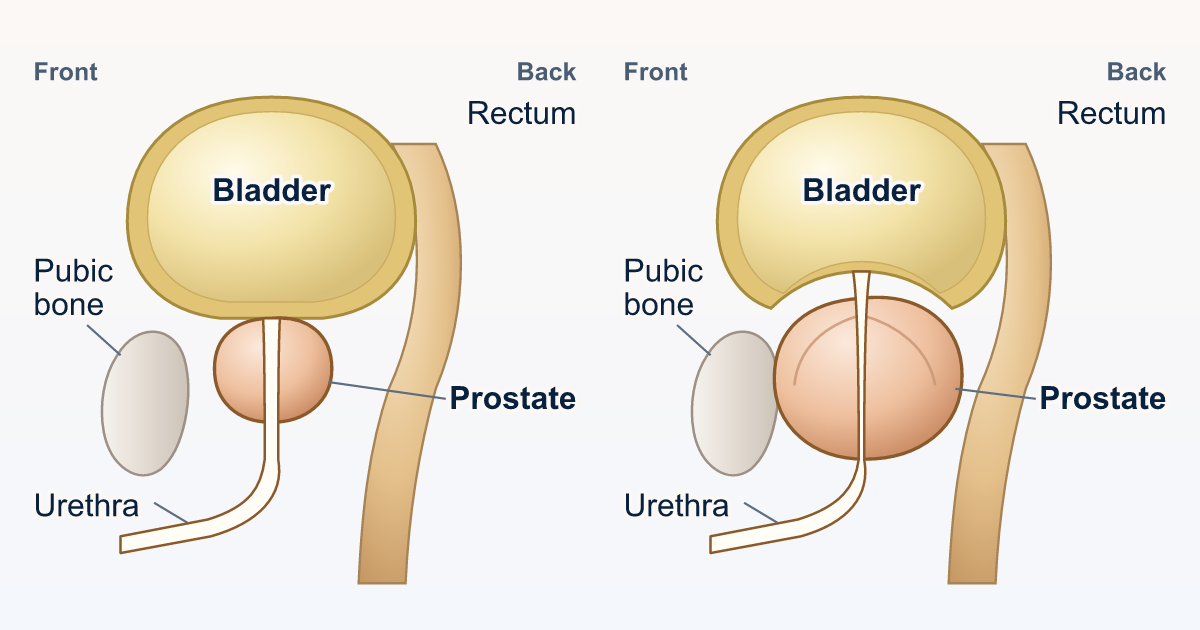
The prostate is a gland that helps make semen. It sits just below the bladder and wraps around the urethra2. As men get older, the prostate often grows. When it grows large enough to press on the urethra, it can change how you urinate.
Typical prostate. The prostate sits below the bladder and wraps around the urethra, the tube that carries urine out.
Enlarged prostate (BPH). A larger prostate can squeeze the urethra and bulge up into the bottom of the bladder. Urine may then flow more slowly, or the bladder may not empty well.
Symptoms of BPH
BPH symptoms affect how you store and pass urine. They can include2:
- a weak or slow urine stream
- trouble starting, or a stream that stops and starts
- needing to go often, or needing to go right away
- waking up at night to urinate
- feeling that your bladder is not empty after you go
- dribbling at the end
- pain when you urinate
Other problems can cause these symptoms too, so it is worth seeing a doctor. Read frequent urination and waking at night.
Is BPH cancer?
No. BPH is a benign, or non-cancer, growth1. But urinary symptoms can come from either BPH or prostate cancer, and a man can have both. A urology guideline recommends talking with your doctor about PSA screening, with advice that depends on your age and risk6. Read is an enlarged prostate the same as prostate cancer?
How BPH is checked
Your doctor will ask about your symptoms, medical history, and medicines, and examine you. The exam may include a rectal exam to feel the prostate. You may also have a urine test, a PSA blood test, a test of how well you hold and release urine, or an ultrasound4. Read prostate size, PSA, and report terms.
Does BPH go away?
BPH often lasts for years. In a large trial that followed men for about 4.5 years, men who took a placebo were more likely to have their BPH get worse than men who took medicine3. Read does an enlarged prostate go away?
Treatment options
Treatment depends on how much your symptoms bother you, your age and health, and the size of your prostate4. What matters to you, such as keeping ejaculation, matters too. Options include2:
- Watch and wait, with simple changes such as drinking less before bed
- Medicine that relaxes or shrinks the prostate (medication for an enlarged prostate)
- Office procedures such as water vapor therapy (Rezum) and prostatic urethral lift (UroLift)
- Prostate artery embolization (PAE), an image-guided procedure through an artery5 (what is PAE?)
- Surgery such as TURP or laser surgery
See BPH treatments side by side.
Questions to ask
- Are my symptoms from BPH, or could something else be causing them?
- How big is my prostate, and does its shape limit my options?
- Which options fit my goals, including keeping ejaculation?
- Should I see both a urologist and an interventional radiologist?
When to get care right away
Go to the nearest emergency department if you cannot urinate at all, or if you have fever and chills with painful urination. Call your doctor soon if you see blood in your urine.
Common questions
What is BPH?
Benign prostatic hyperplasia (BPH) means the prostate has grown larger. It is common as men get older. It is not cancer, but it can press on the tube that carries urine and make urinating harder.
What are the first signs of an enlarged prostate?
Common early signs are a weaker stream, trouble starting, needing to go more often, and waking at night to urinate. Other problems can cause these too, so see your doctor.
Can BPH turn into cancer?
BPH is not cancer and is a different condition. But urinary symptoms can come from either, and a man can have both. Ask your doctor whether PSA screening makes sense for you.
Does an enlarged prostate always need treatment?
No. Mild symptoms are often watched over time. Treatment is usually for symptoms that bother you or for problems such as not being able to urinate.
Sources
- AUA guideline on urinary symptoms from BPH, Part I, J Urol 2021 (PMID 34384237) ↩︎
- NIDDK, prostate enlargement (benign prostatic hyperplasia) ↩︎
- McConnell et al., MTOPS trial, NEJM 2003 (PMID 14681504) ↩︎
- MedlinePlus, enlarged prostate (BPH) ↩︎
- Society of Interventional Radiology, enlarged prostate and PAE ↩︎
- AUA/SUO guideline on early detection of prostate cancer, J Urol 2023 (PMID 37096582) ↩︎