
Key facts
- UFE is for fibroids that cause symptoms, such as heavy periods, pain, or pressure. It is not done during pregnancy, for fibroids that cause no symptoms, or when cancer or a pelvic infection is possible2,1.
- It keeps the uterus, and there is no cut in the belly.
- Pelvic cramps are common for several days. Many people return to normal activities in 1 to 2 weeks1.
- In randomized trials, about 1 in 3 people needed another fibroid treatment within 5 years. Most did not need a hysterectomy later3,4.
- If a future pregnancy is your main goal, limited data suggest talking about myomectomy first5.
How UFE works
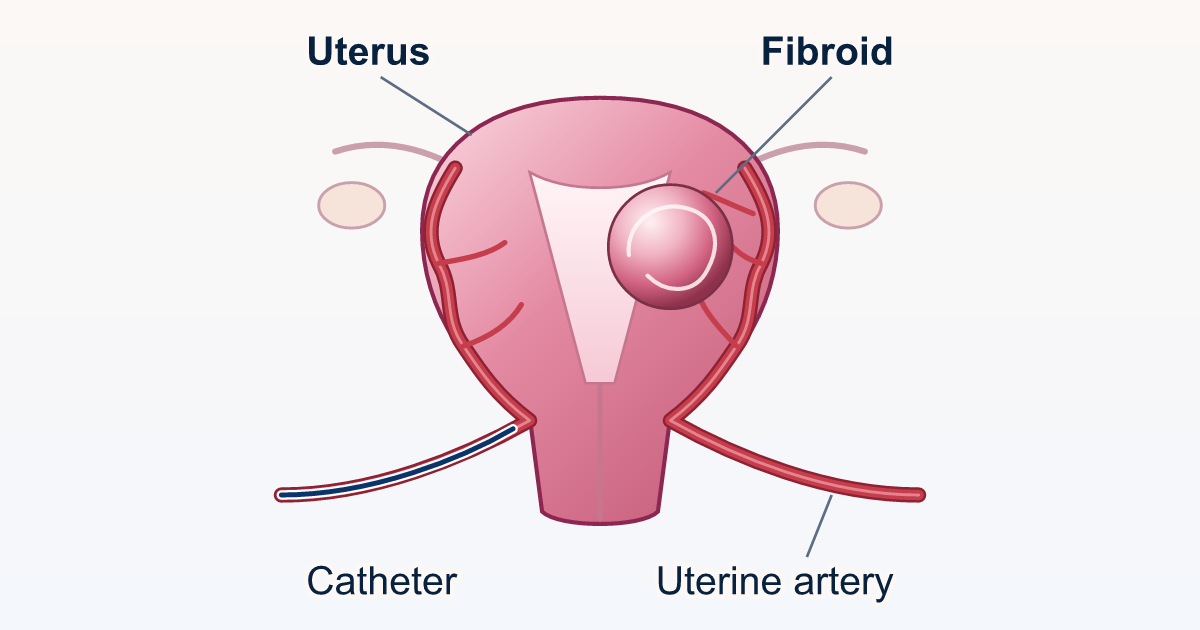
Fibroids need a steady blood supply to grow. In UFE, the doctor puts tiny particles into the arteries that feed the uterus. The particles lodge in the small vessels that feed the fibroids and slow their blood flow. The fibroids shrink and soften over about 6 months, and symptoms often start to improve within 2 to 3 weeks1.
Step 1. A small catheter is steered through the arteries to the uterine artery, using X-ray pictures.
Step 2. Tiny particles go in through the catheter. They lodge in the small vessels that feed the fibroid and slow its blood flow. This is done on both sides.
Step 3. The catheter is removed. With less blood flow, the fibroid shrinks and softens over about 6 months, and the uterus stays in place.
UFE is done by an interventional radiologist. The small catheter usually goes in at the wrist or the groin. Read more about interventional radiology.
UFE vs UAE: two names, one procedure
UFE and UAE are two names for the same procedure1. UAE names the blood vessels that are treated: the uterine arteries. UFE names what is being treated: the fibroids. You may see either name in research papers and patient guides, and your doctor may use either one.
Who might think about UFE
UFE may be an option if fibroids cause heavy or long periods, pelvic pain or pressure, or frequent urination1, and you want to avoid a hysterectomy1. The right choice depends on your symptoms, the size and place of your fibroids, and whether you want to become pregnant.
Before UFE, you need imaging, usually an MRI or ultrasound, and a gynecologic exam. Your doctor needs to rule out cancer first, because UFE is not done when cancer is a possibility1.
What UFE is like
Before. You meet the interventional radiologist to talk about your symptoms, your imaging, and your goals. Bring your questions.
During. You get numbing medicine at the skin and medicine through an IV to help you relax. Depending on how much relaxing medicine you get, you may or may not stay awake. The doctor uses X-ray pictures to guide the catheter to the arteries on both sides of the uterus1.
After. Pelvic cramps are common for several days. They are worst in the first 24 hours and then get better quickly. You may also have mild nausea and a low fever1. Read the UFE recovery timeline.
Results
Success can mean less bleeding and pain, smaller fibroids on imaging, or not needing another treatment. These do not always move together. In randomized trials, about 1 in 3 people needed another fibroid treatment within 5 years, and most did not need a hysterectomy later3,4. In one trial that compared UFE with myomectomy, quality-of-life scores at 2 years were somewhat better after myomectomy6.
Read more in does UFE work, and can fibroids grow back?
Risks to ask about
Like any procedure, UFE has risks. They include infection, bleeding or bruising where the catheter went in, damage to the blood vessel, an allergic reaction to the X-ray dye, and particles lodging in the wrong place. Early menopause can happen, more often after age 451. The evidence on how UFE affects a future pregnancy is unclear right now and is still being studied1,2. Some people pass small pieces of fibroid tissue afterward. This can happen when a fibroid sits inside the uterine cavity (a submucosal fibroid). It is usually harmless, but tell your doctor if it happens, because a few people need a short procedure to clear the uterus1.
Read UFE and menopause and pregnancy after fibroid treatment.
UFE and your other options
If fibroids cause no symptoms, you may not need treatment7. Other options include medicine, focused ultrasound, myomectomy, and hysterectomy8. A gynecologist and an interventional radiologist can each explain the options they offer. It is fine to ask for both views.
See fibroid treatments side by side, UFE vs myomectomy, and UFE vs hysterectomy.
Questions to ask
- Are my fibroids a good fit for UFE, based on their size and where they are?
- What results should I expect for my symptoms?
- How does UFE compare with myomectomy or hysterectomy for me?
- How might UFE affect pregnancy or menopause for me?
Common questions
Is UAE the same as UFE?
Yes. They are two names for the same procedure, which blocks the blood flow that feeds fibroids1.
Is UFE surgery?
UFE is not open surgery. It is a procedure done through a small catheter in an artery, usually at the wrist or groin. There is no cut in the belly, and the uterus stays in place.
Does UFE hurt?
Pelvic cramps are common for several days after UFE and are worst in the first 24 hours. Your team plans pain medicine before you go home. Ask which symptoms should make you call.
Can fibroids come back after UFE?
They can. In randomized trials, about 1 in 3 people needed another fibroid treatment within 5 years. Most did not need a hysterectomy later.
Can I get pregnant after UFE?
The evidence on how UFE affects pregnancy is unclear right now and is still being studied. Healthy pregnancies have been reported after UFE. If pregnancy is your main goal, limited data suggest talking about myomectomy first. Ask your gynecologist.
How do I find out if UFE is right for me?
Ask your gynecologist about all of your options, or ask for a referral to an interventional radiologist for a UFE consult. Bring your pelvic ultrasound or MRI reports.
Sources
- RadiologyInfo.org (ACR/RSNA), uterine fibroid embolization ↩︎
- RCOG/RCR, clinical recommendations on uterine artery embolisation, 2013 ↩︎
- REST trial, 5-year results (PMID 21481151) ↩︎
- EMMY trial, 10-year results (PMID 27393268) ↩︎
- Mara 2008, UAE compared with myomectomy, reproductive results (PMID 17943348) ↩︎
- FEMME trial, UFE versus myomectomy (PMID 32726530) ↩︎
- MedlinePlus, uterine fibroids ↩︎
- ACR Appropriateness Criteria, fibroids, 2023 (PMID 38823944) ↩︎