
Key facts
- Interventional radiologists are doctors. They use imaging to see inside the body while they treat it.
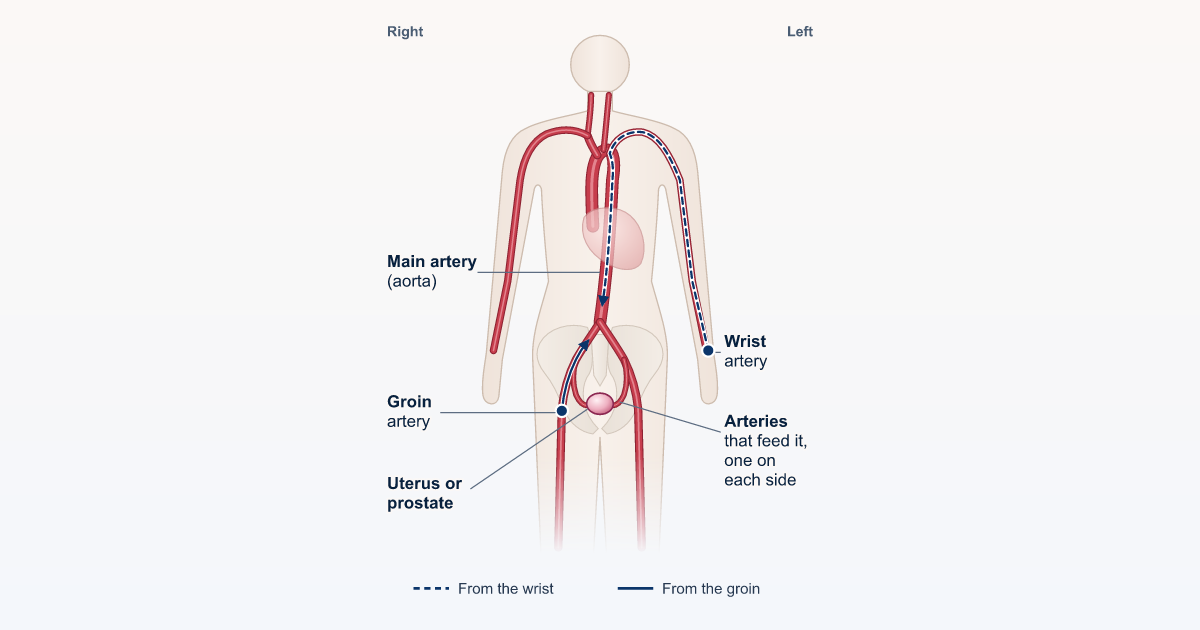
- Many IR treatments start with a small nick in the skin, often at the groin or wrist, and a small catheter travels inside a blood vessel1,2.
- You are usually awake. Numbing medicine is used at the skin, and many people also get medicine to help them relax1.
- You can ask about an IR treatment even if no one has brought it up. Ask your doctor for a referral, and check what your insurance plan needs.
What interventional radiologists do
Radiologists are doctors who read X-rays, ultrasound, CT, and MRI. Interventional radiologists also use those pictures to treat disease. They watch a live image on a screen while they guide a small catheter, a thin flexible tube, to the right spot1.
Because the doctor works from inside a blood vessel, many IR treatments do not need a large cut. That can mean less time in the hospital than surgery for some conditions. It does not mean IR is always the better choice. Each option has its own benefits and risks.
Interventional radiologists often work with your other doctors. For fibroids, that is usually a gynecologist. For an enlarged prostate, that is usually a urologist.
How an image-guided procedure works
Every procedure is different, but many follow the same basic steps1:
- You lie on a table. A nurse may give you medicine through an IV to help you relax.
- The doctor numbs a small spot of skin, often at the groin or the wrist2.
- A small catheter goes into an artery through a tiny opening. You should not feel the catheter moving inside.
- The doctor injects contrast dye and takes X-ray pictures to see the arteries, then steers the catheter to the target.
- The treatment is done through the catheter. For UFE, tiny particles block blood flow to the fibroids2. For PAE, they block blood flow to parts of the prostate4.
- The catheter comes out, and the opening is closed with pressure or a small device.
Afterward, you may need to lie flat for several hours, which some people find the hardest part1. Your team will tell you what to expect for your procedure.
IR treatments covered on ProcedurePath
Uterine fibroid embolization (UFE). UFE treats fibroids that cause heavy periods, pain, or pressure. Tiny particles slow the blood flow that feeds the fibroids, so they shrink, and the uterus stays in place2. Read what UFE is.
Prostate artery embolization (PAE). PAE treats urinary symptoms from an enlarged prostate. Tiny particles block blood flow to parts of the prostate, so it shrinks, which can ease symptoms3,4. Read what PAE is.
Interventional radiologists treat many other conditions too. ProcedurePath covers fibroids and an enlarged prostate for now.
How to see an interventional radiologist
You can ask about UFE or PAE even if no one has mentioned it. Here is how to get a visit:
- Ask for a referral. Ask your gynecologist, urologist, or primary care doctor to refer you to an interventional radiologist. Referral rules vary by practice and plan; ask the office.
- Check your coverage. Call the number on your insurance card. Ask whether you need a referral, and which interventional radiology clinics are in your network.
- Find a clinic. The Society of Interventional Radiology has a doctor finder. Many hospitals also list IR clinics on their websites. Read how to find an interventional radiologist for more places to look and what to ask when you call.
- Bring your records. Bring your imaging reports, a list of your medicines, and your questions. For fibroids, that often means a pelvic ultrasound or MRI. For an enlarged prostate, bring your PSA results and any prostate imaging.
An IR consult is a visit to talk, not a promise to have a procedure. You can ask questions and decide later.
Questions to ask at an IR visit
- Am I a good fit for this procedure? Why or why not?
- What other options should I think about, including medicine and surgery?
- Will you go in through my wrist or my groin?
- What will recovery be like, and when can I go back to work?
- What are the main risks, and how often do they happen in your practice?
- Who do I call if something feels wrong after I go home?
Who writes this page
This page is written by Varun Danda, MD, an interventional radiology resident physician. That is the specialty that does UFE and PAE, so we say it up front. ProcedurePath covers every option, including medicine and surgery. Read how we write and review.
Common questions
Is an interventional radiologist a real doctor?
Yes. Interventional radiologists are medical doctors. They specialize in using imaging to guide treatments inside the body.
Is interventional radiology the same as surgery?
Not quite. Most IR treatments work through a small catheter in a blood vessel, so they do not need a large cut. They are still medical procedures with real risks, and your doctor should explain them.
Do I need a referral to see an interventional radiologist?
Many people are referred by a gynecologist, urologist, or primary care doctor. Referral rules vary by practice and plan; ask the office. Check with your insurance plan first.
Will I be asleep for an IR procedure?
Usually not. Numbing medicine is used at the skin, and many people also get medicine through an IV to help them relax. Ask your team what to expect for your procedure.