
Key facts
- GAE is for knee arthritis pain that has not improved enough with treatments such as physical therapy, weight management, or injections2.
- It is done through a small catheter with numbing medicine and often light sedation. Most people go home the same day2.
- GAE targets inflamed tissue in the joint lining. It does not rebuild worn cartilage, and some people may still need a knee replacement later1,2.
- Evidence status as of October 2026: one small sham-controlled trial found less pain after GAE, and two larger ones found no clear difference from a sham procedure3.
How GAE works
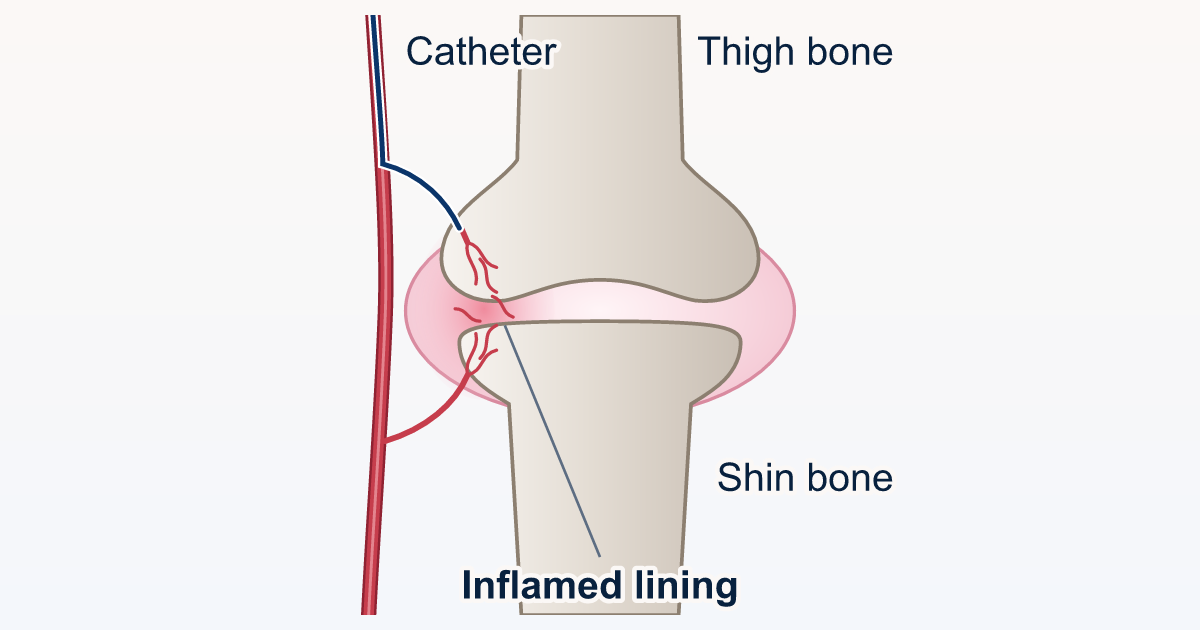
Osteoarthritis wears away the cartilage that cushions the knee. It also causes ongoing inflammation2. In many people, the joint lining (the synovium) becomes inflamed and grows extra small blood vessels. Researchers think these vessels, and the nerves that grow along with them, add to knee pain1.
The small arteries around the knee are called the genicular arteries. In GAE, the doctor places tiny particles in the branches that feed the inflamed lining. The goal is to calm the inflammation and ease pain1,2. Some doctors use particles that dissolve over time, and others use permanent ones. There is no agreed best choice yet1.
Step 1. A small catheter is steered through the arteries to the small arteries around the knee, using X-ray pictures.
Step 2. Tiny particles go in through the catheter and slow blood flow to the extra small vessels in the inflamed lining.
Step 3. The catheter is removed. The goal is for the lining to become less inflamed, which may ease pain.
GAE does not rebuild cartilage or change the bones of the knee. It is a treatment for pain, not a cure for arthritis.
What GAE is like
Before. You meet the interventional radiologist to talk about your knee pain, the treatments you have tried, and your goals. Your team may ask for a recent standing knee X-ray and a knee MRI2.
During. GAE is usually an outpatient procedure. It is done with numbing medicine at the skin, often with medicine to help you relax. The catheter usually goes in at the groin, and sometimes at the wrist. The procedure often takes about 1 to 2 hours2.
After. Most people go home within a few hours. Many teams advise no heavy lifting, straining, or hard exercise for 1 to 2 days. If relief comes, it may start within hours to weeks2. Follow your care team's instructions.
What studies show so far
Many early studies reported less knee pain after GAE, but most had no comparison group. In one early single-center, uncontrolled study, about 80% of patients still had meaningful relief 3 years after GAE4. In a longer-term study of 46 people, average pain scores fell from about 59 to about 38 out of 100 after 2 years5.
Studies without a comparison group cannot tell how much of the benefit comes from GAE itself and how much comes from the placebo effect. That is why sham-controlled trials matter. In these trials, some people get a fake (sham) procedure instead, so researchers can compare.
Sham-controlled trials are mixed so far:
- In a small trial of 21 people, pain improved more after GAE than after the sham procedure at 1 month6.
- In a trial of 59 people, there was no significant difference between GAE and the sham procedure at 12 months7.
- In a trial of 58 people, there was no significant difference at 4 months or at 12 months8,9.
A 2025 review of the studies said the benefit over placebo "remains uncertain"10. Experts disagree about what this means. The Society of Interventional Radiology (SIR), the main U.S. group for interventional radiologists, calls GAE "an established treatment option" and not an experimental one1. NICE, which reviews treatments in the UK, says the evidence on how well it works is not yet strong enough, so GAE should be used only in research11. More randomized trials, comparing GAE with a sham procedure or with a steroid injection, are still underway12. Read what each trial found.
Who GAE has been studied in
Most studies included adults over 40 whose knee pain lasted despite at least 3 to 6 months of other treatment. Studies have included mild to severe arthritis on X-rays, but pain tended to improve more in mild to moderate arthritis than in severe arthritis2.
SIR describes GAE for people whose pain has not improved with other care and who cannot have, do not want, or want to put off a knee replacement1. Your doctor can tell you whether your knee and your X-rays fit the people who have been studied.
GAE and knee replacement
GAE does not replace a knee replacement, and some people may still need a knee replacement later2. In one study, 9 of 46 people later had a knee replacement, and their surgeons reported no extra difficulty during the operation5. It is not yet known whether GAE can put off a knee replacement. Compare GAE and knee replacement.
Can GAE be repeated?
Repeat GAE has not been well studied. One expert review says a second GAE may be considered if the first did not help, about a year after the first one2. Ask your doctor what would happen next if your pain comes back.
Risks to ask about
In studies so far, serious problems have been rare, and most side effects went away on their own3. But GAE has risks, like any procedure.
- Skin color change over the knee. This is the most common side effect. It happened in about 16 in 100 people in one large review13, and it usually goes away within a month1. It happens when some particles reach small arteries that feed the skin instead of the joint lining2.
- Knee pain for a short time after the procedure. This happened in about 10 in 100 people13.
- Less common problems. These include bleeding or bruising where the catheter went in, a blood clot in a leg vein5, and, rarely, a small skin sore over the knee (about 3 in 1,000)1.
Read more about GAE side effects and recovery.
Questions to ask
- Does my knee pain and my X-ray fit the people GAE has been studied in?
- Which particles do you use, and why?
- What results do you see in your own patients, and how do you measure them?
- What would we try next if GAE does not help?
Who performs GAE
GAE is performed by interventional radiologists1. NICE says it should be done only by interventional radiologists with specific training in GAE11. It is fair to ask how many GAE procedures your doctor has done. Read more about interventional radiology.
Common questions
What is GAE?
GAE is a procedure for knee pain from osteoarthritis. A doctor uses a small catheter to place tiny particles in the small arteries around the knee, to slow blood flow to inflamed tissue in the joint lining. It is still being studied.
Is GAE surgery?
GAE is not open surgery. It is done through a small catheter placed in an artery, usually at the groin, with numbing medicine and often light sedation. Most people go home the same day.
Does GAE fix cartilage?
No. GAE targets inflamed tissue and extra blood vessels in the joint lining. It does not rebuild worn cartilage, and some people may still need a knee replacement later.
Bring questions to your visit
A printable list of questions about GAE, with background notes from the sources. Talk with your doctor about these questions.
Questions to ask before GAESources
- Ahmed et al., Society of Interventional Radiology position statement on genicular artery embolization, Journal of Vascular and Interventional Radiology 2026 (PMID 42118083) ↩︎
- Brown et al., genicular artery embolization: a technical review, Journal of Clinical Medicine 2025 (PMID 40142914) ↩︎
- Collettini et al., embolization for knee osteoarthritis: mechanism and current results, Deutsches Ärzteblatt International 2026 (PMID 41495011) ↩︎
- Okuno et al., midterm results after embolization for knee osteoarthritis, Journal of Vascular and Interventional Radiology 2017 (PMID 28365171) ↩︎
- Little et al., GENESIS long-term results, CardioVascular and Interventional Radiology 2024 (PMID 38819473) ↩︎
- Bagla et al., multicenter sham-controlled trial of GAE, Journal of Vascular and Interventional Radiology 2022 (PMID 34610422) ↩︎
- Landers et al., triple-blind sham-controlled trial of GAE, Bone & Joint Open 2023 (PMID 37051829) ↩︎
- van Zadelhoff et al., double-blind sham-controlled trial of GAE, 4-month results, BMJ Open 2024 (PMID 39353688) ↩︎
- van Zadelhoff et al., the same trial at 12 months, European Radiology 2026 (PMID 42009866) ↩︎
- Abussa and Jeremic, systematic review and meta-analysis of GAE, Academic Radiology 2025 (PMID 40425436) ↩︎
- NICE (UK), genicular artery embolisation for pain from knee osteoarthritis, HTG595 (formerly IPG708), 2021 ↩︎
- ClinicalTrials.gov, registered trials of genicular artery embolization for knee osteoarthritis ↩︎
- Ashraf et al., systematic review of GAE safety and results, 2025 (PMID 40219609) ↩︎
- CMS, Medicare-approved investigational device exemption (IDE) studies ↩︎