
Key facts
- PAE is for bothersome urinary symptoms from BPH. It is not a cancer treatment.
- PAE uses local (numbing) anesthesia. TURP surgery uses spinal or general anesthesia3.
- Urinary symptoms can get worse for 3 to 7 days before they get better2.
- In a sham-controlled trial, symptoms improved more after PAE than after a fake procedure4.
How PAE works
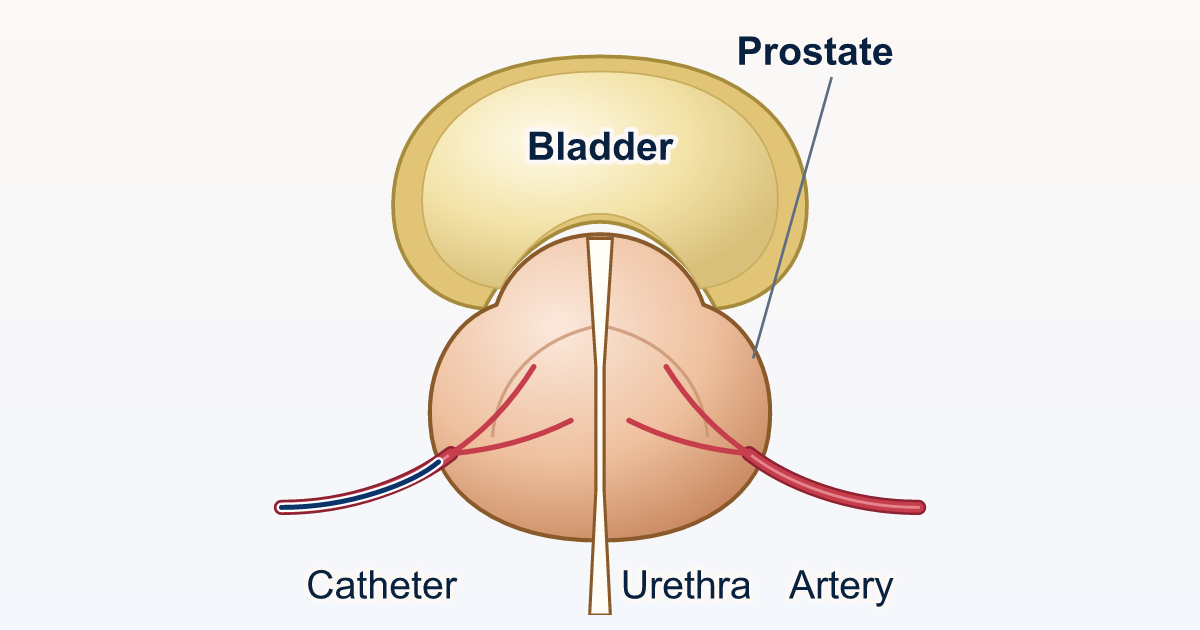
The prostate gets blood from small arteries on each side. In PAE, the doctor puts tiny particles into those arteries to block blood flow to parts of the prostate. Without that blood supply, the prostate stops growing and begins to shrink2,1. A growing prostate squeezes the urethra, the tube that carries urine out5, so a smaller prostate can ease symptoms2.
Step 1. A small catheter is steered through the arteries to the prostate arteries, using X-ray pictures.
Step 2. Tiny particles go in through the catheter and slow the blood supply to parts of the prostate.
Step 3. The catheter is removed. Without that blood supply, the prostate stops growing and begins to shrink, which can ease pressure on the urethra.
PAE is done by an interventional radiologist. The small catheter usually goes in at the wrist or the groin. Read more about interventional radiology.
Who might think about PAE
PAE may be an option for men whose urinary symptoms from BPH bother them, including men who want to avoid surgery or who care about keeping ejaculation. The workup usually includes a medical history, an exam, a urine test, and often a PSA blood test or an ultrasound6. Your team will tell you which scans you need before PAE.
It is a good idea to hear from both a urologist and an interventional radiologist before you choose. They can tell you which options fit the size and shape of your prostate.
What PAE is like
Before. You meet the interventional radiologist to talk about your symptoms, your tests, and your goals. Bring your questions.
During. PAE is done with numbing medicine at the skin3. Many centers also give medicine to help you relax. The doctor uses X-ray pictures to find the small arteries on each side of the prostate.
After. Most men go home the same day. Urinary symptoms can get worse for 3 to 7 days, and you may have a fever, nausea, or small amounts of blood in the urine or stool2. Some men have a short group of symptoms called post-PAE syndrome7. Read how long PAE recovery takes.
Results
In a sham-controlled trial, symptom scores improved more after PAE than after a fake procedure4. A review of trials comparing PAE with TURP surgery found that symptom scores may improve about as much in the first year, though the evidence is low certainty. Men were likely to need another treatment more often after PAE8.
In one of those trials, urine flow improved more after TURP. Ejaculation problems were reported less often after PAE, but the difference may have been due to chance, and more than half of the men assessed after PAE still reported them3.
Read more in how well PAE works and how long it lasts and PAE vs TURP.
Risks to ask about
Like any procedure, PAE has risks. Minor side effects include frequent or difficult urination, pelvic pain, blood in the urine or stool, and diarrhea. Most go away on their own1. Rarely, swelling makes it impossible to urinate for a while, and you may need a catheter2. In one trial, fewer side effects were reported after PAE than after TURP3. Ask your doctor how often each risk happens in their practice.
PAE and your other options
Other options include watchful waiting, medicine, office procedures such as water vapor therapy (Rezum) and prostatic urethral lift (UroLift), and surgery such as TURP or laser surgery5. Each has its own tradeoffs for urination, recovery, and sexual function.
See BPH treatments side by side, PAE vs Rezum vs UroLift, and sexual side effects by treatment.
Questions to ask
- Is my prostate a good fit for PAE, based on its size and shape?
- What results should I expect for my symptoms?
- How does PAE compare with TURP, Rezum, or UroLift for me?
- How might PAE affect ejaculation or erections?
Common questions
Is PAE surgery?
PAE is not open surgery. It is a procedure done through a small catheter in an artery, usually at the wrist or groin, with numbing medicine. No prostate tissue is cut out.
Does PAE affect sex?
In one trial, ejaculation problems were reported less often after PAE than after TURP, but the difference may have been due to chance. No BPH treatment is free of possible sexual side effects. Ask your urologist and interventional radiologist what to expect for you.
How soon does PAE work?
After PAE, the prostate stops growing and begins to shrink, so symptoms often improve gradually. For the first 3 to 7 days, urinary symptoms can get worse before they get better.
How do I find out if PAE is right for me?
Ask your urologist about all of your options, or ask for a referral to an interventional radiologist for a PAE consult. Bring your PSA results and any prostate imaging reports.
Sources
- Society of Interventional Radiology, enlarged prostate and PAE ↩︎
- UW Medicine, prostatic artery embolization patient leaflet, 2024 ↩︎
- Abt et al., PAE versus TURP trial, BMJ 2018 (PMID 29921613) ↩︎
- Pisco et al., PAE versus sham trial, European Urology 2020 (PMID 31831295) ↩︎
- NIDDK, prostate enlargement (benign prostatic hyperplasia) ↩︎
- MedlinePlus, enlarged prostate (BPH) ↩︎
- Post-PAE syndrome systematic review, 2020 ↩︎
- Cochrane review, PAE compared with other procedures for BPH, 2022 (PMID 35349161) ↩︎